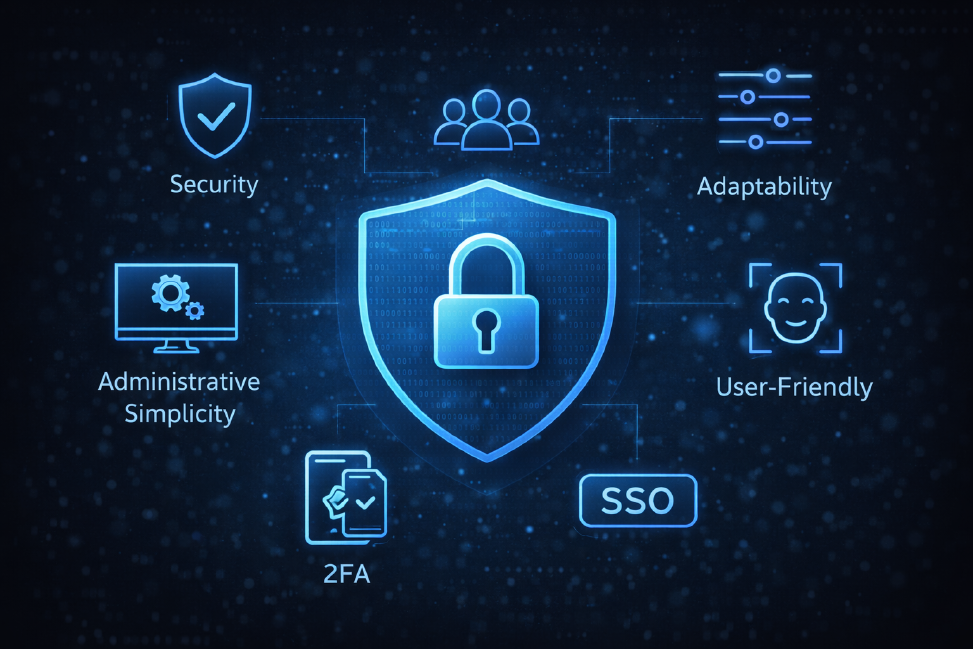
Today’s customers expect modern authentication systems to offer security, user-friendliness, flexibility, and data minimization. Learn more here.
Introduction to Modern Authentication Systems
In an era where digitalization permeates virtually every aspect of life, modern online access systems are crucial. They form the gateway to a multitude of services, from e-commerce platforms and online banking to social networks and enterprise applications. Customer expectations of these systems have steadily increased in recent years. They demand not only fast, intuitive, and seamless usability to avoid deterring not very tech-savvy users, but also a high degree of security and flexibility. This presents developers and providers with the challenge of creating systems that meet these diverse requirements.
A successful access system is therefore the result of a careful balance between user-friendliness and security, complemented by the possibility of personalization and adaptation to individual needs.
Technological progress continually necessitates the development of new access factors to introduce secure and more user-friendly methods (e.g., biometrics, two-factor authentication (2FA), and single sign-on (SSO)) to the market, in addition to traditional methods like username/password. Due to the rapid evolution of the online world and emerging technological possibilities, this will continue to require ongoing adjustments to systems in the future. But what can customers expect from a modern online access system today?
User-Friendliness for a Successful Customer Journey
User-friendliness is a key feature of any successful online access system. Users expect to be able to register effortlessly and quickly, and to perform their desired actions without major obstacles. This starts with straightforward registration fields and extends to all subsequent processes, which should self-explanatory. Lengthy forms, complicated processes, and unclear procedures generally deter potential users.
However, navigation with clearly structured menus, the number of clicks required, understandable icons, consistent user guidance, and an appealing design within the system are also crucial factors for a positive user experience. In addition to unnecessary clicks and superfluous, time-consuming form fields, long loading times pose a risk of frustrated users abandoning the process.
To minimize the number of clicks and required input while simultaneously increasing security, login methods such as Single Sign-On (SSO) were developed and are becoming increasingly popular. With a one-click process like Social Login, users don’t have to repeatedly register and log in to different services. Through federation, they can easily and quickly log in to cooperating services using their existing credentials. Account data already stored with another service is used to simplify further registration and login requirements. In addition to this type of Social Login for personal use, Enterprise Login offers a similarly user-friendly Single Sign-On experience in the corporate environment. Employees only need to log in once to gain access to multiple websites, applications, or partner services without having to re-enter their login credentials. This simplifies access and contributes to a consistently seamless user experience.
Finally, accessibility should always play a central role when choosing a suitable access system. A modern login must be able to accommodate the needs of diverse user groups, including people with disabilities. This includes support for screen readers, sufficient contrast, and the ability to adjust font size. Accessible design is not only a sign of inclusion but also significantly expands the system’s potential user base.
User-Friendly Authentication Systems Without Password Entry or Low-Password Procedures
For years we’ve known that using secure passwords is a barrier for many users in the online world. Strong passwords are difficult to remember, are regularly forgotten, and are also a frequent target for attacks. Accordingly, users today appreciate it when login procedures do without traditional passwords or at least significantly reduce their use.
With passwordless login, authentication happens entirely without a password. One example are so-called Magic Links: After entering their e-mail address, users receive a unique login link that grants them direct access. Biometric methods such as fingerprint or facial recognition, as well as the increasingly popular passkeys, are also common.
A low-password login refers to a process where passwords still exist, but the user rarely needs to actively use them. This includes, for example, the single sign-on (SSO) process, where existing login credentials from an existing account – such as from a professional or social network – can be used. After logging in once, multiple applications or services can be used without re-entering the login details.
Growing Security Requirements for a Modern Online Access System
The security of online access systems is a crucial factor in user trust. Given the ever increasing cyber threats, authentication systems today must offer reliable protection mechanisms. Therefore, it is advisable to use passwordless systems (e.g., biometrics, passkeys) or multi-factor authentication systems.
If traditional access systems like usernames and passwords are to continue to be used, password strength checks, comparison with known compromised password databases, and lockout functionality are considered minimum standards. However, passwords alone are insufficient to guarantee a high level of security. This can be remedied by implementing multi-factor authentication (MFA), which uses an additional factor such as biometric fingerprint or facial recognition, as well as an authenticator app, to provide extra security. These factors should be used primarily to protect mobile applications and portals to offer the best possible protection against phishing attacks and malware. Conversely, well-known but easily compromised access methods like SMS OTP, where a one-time password is sent via SMS, should be avoided entirely.
Another important component is the introduction of established security standards such as OpenID Connect (OIDC), OAuth 2.0, and FIDO2, which support additional convenient methods like single sign-on, passwordless login, and social login. For companies, the use of such standards also means easier integration of various applications, centrally managed identities, and the use of modern, streamlined data formats such as JSON Web Tokens (JWT). This allows security and user-friendliness to be combined without creating additional complexity for users.
Furthermore, sensitive data, especially login credentials, should be encrypted both during transmission and at rest. In addition, systems should be regularly checked for vulnerabilities, and security updates and patches should be installed to defend against new threats.
Modern cryptographic authentication methods, such as FIDO2-based passkeys, already significantly reduce many traditional attacks on access systems. Monitoring and anomaly detection systems can be used to identify unusual activity or attacks on applications and infrastructure at an early stage. Users should also be notified of suspicious activity on their accounts so they can react quickly if necessary.
Finally, real-time notifications and updates can alert users to unwanted access attempts, especially if they originate from a new device or use a new authentication factor.
The Need for Personalization and Adaptability in an Authentication System
In the digital world, a clear corporate identity is a clear competitive advantage. It is therefore important for most companies to present the entire customer journey in a consistent look and feel, from the login page to the actual application pages to the supposed logout page. This means that the personalization and customization of an authentication system, which is usually sourced externally, is of crucial importance.
This starts with the ability to customize or personalize the layout and language of the user interface, but goes much further to defining certain access rules or specifying the required security levels.
At Engity, for example, we enable individual user interfaces, customized communication templates, localized content, the use of own domains, and flexible extensions via hooks.
Users should also be able to freely choose their preferred access methods. While some users prefer traditional password authentication, others rely on biometric methods such as fingerprint or facial recognition. A flexible access system with various authentication options supports user preferences in the best possible way and increases user acceptance at the same time.
Easy Integration Option
In today’s fast-paced world, online access systems are expected to be quick and easy to deploy and manage across all system landscapes, whether mobile or desktop – regardless of whether a smartphone, tablet, laptop, or desktop computer needs to authenticate, or whether it’s servers, machines, or networks. Consequently, user interfaces must be responsive and adapt to different screen sizes, and it must be ensured that content is available on smaller screens with comparable functionality to desktop versions.
Self-Service Function Instead of Support Tickets
Modern online access systems should be self-explanatory and give users as much control as possible over their accounts. For example, automated registration systems, automated password reset functions, automatic password changes, and self-service account deletion options significantly increase customer satisfaction, as users can manage their accounts independently around the clock. This eliminates the need for users to write lengthy support requests or wait for a response to a manually generated support ticket, which often takes a considerable amount of time.
Other important features include the ability to independently manage various access factors, such as replacing an authenticator app or a YubiKey.
Legal and Data Protection Requirements for a Modern Access System
Data protection and legal aspects play a central role in the design of modern online access systems. Users entrust their personal data to these systems and expect those data to be handled securely and responsibly. This requires compliance with strict data protection laws and guidelines, such as the General Data Protection Regulation (GDPR) or the NIS-2 Directive in the EU. Legal requirements also often stipulate minimum standards for how companies must protect their corporate access, such as the mandatory use of stronger authentication methods like multi-factor authentication for critical infrastructure companies or companies that process highly sensitive data (such as health or tax data). Failure to comply with these regulations when handling personal data can quickly lead to substantial penalties.
In the financial sector, the PSD2 (Payment Services Directive 2) directive also sets corresponding standards: Online banking access must generally be secured by strong customer authentication, typically two-factor authentication. Such regulations increase the overall level of safety.
Infrastructure Requirements to Ensure the Necessary Performance and Reliability
In addition to the aforementioned aspects, the ever-increasing availability of systems plays a crucial role today. Even a well-designed system tailored to user needs fails to fulfill its purpose if access is unreliable or involves noticeable waiting times.
This ensures that users can log in at any time, downtime is kept to a minimum, and maintenance work is preferably carried out during off-peak hours.
Conclusion and Outlook on Future Developments
Technology is constantly evolving, and modern online authentication systems must keep pace with these developments to remain competitive.
Customer expectations for modern online access systems are high and diverse. Security, user-friendliness, and flexibility are key requirements that a successful system must meet. Advancing technology offers numerous opportunities to fulfill these requirements while simultaneously setting new standards. The integration of mobile solutions will also continue to grow in importance as more and more users shift their activities to mobile devices.
Companies that are able to strike this balance and continuously work on improving their systems will be able to gain and maintain the trust and loyalty of their users. Technological developments offer numerous opportunities that must be seized to meet the increasing demands of users.