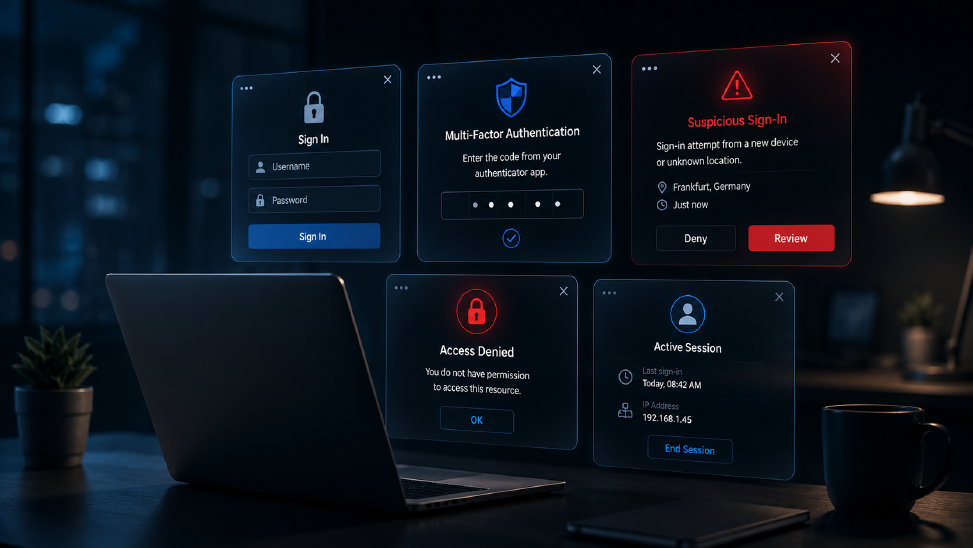
Access management systems (IAM systems) are now among the core security components of modern enterprises. They control who is permitted to access applications, systems, and sensitive data - and prevent unauthorized individuals from gaining access to protected resources.
We have explained what exactly identity and access management entails and what tasks IAM systems perform in a separate article.
At the same time, such systems have become targets in their own right. Today, the exploitation of technical security vulnerabilities is no longer the only method used; instead, compromised identities, stolen access credentials, and insecure authentication procedures have become some of the most common causes of successful cyberattacks.
If an access management system is compromised, the consequences can be far-reaching - ranging from data loss and financial damage to significant impacts on business operations and customer trust.
It is therefore all the more important to detect security incidents early, respond quickly, and implement appropriate protective measures. This article outlines the most relevant types of attacks, the steps to take in an emergency, and how access management systems can be better secured in the long term.
Recognizing Signs of a Hack
Detecting an attack on an access management system can be challenging, especially when attackers specifically exploit compromised identities rather than traditional security vulnerabilities. Nevertheless, there are various warning signs that may indicate a compromise.
A common indicator is unusual sign-in activity in the sign-in logs. This includes, for example, logins outside of standard working hours, access from unusual geographic regions, or a high number of failed login attempts. So-called “impossible travel” scenarios - where a user appears to log in from different continents within a short period - should also be investigated further.
Unexpected changes to permissions or administrator accounts are also critical. If standard users suddenly gain elevated privileges, new admin accounts appear, or modifications are made to security groups, this may indicate an ongoing compromise. The use of inactive accounts belonging to former employees poses a particularly high risk.
Technical anomalies should also be taken seriously. These include, for example, tampered or disabled audit logs, unusual API activity, or unauthorized changes to the IAM configuration. Such actions are often intended to cover one’s tracks or secure persistent access.
Furthermore, unusual user behavior can indicate an attack. If a user suddenly accesses an unusually large amount of data or systems that are not normally accessed, this may signal data exfiltration or “lateral movement” activities, in which attackers move progressively through a network.
If such signs are detected early, companies can react more quickly and significantly limit potential damage.
Immediate Steps to Take After a Hack
If an attack on an access management system is detected, speed matters a lot, but structure matters even more. The aim of the initial measures is to contain the attack, secure affected systems, and prevent further damage.
In doing so, companies should follow a clear procedure - ranging from the immediate isolation of affected systems to technical analysis and long-term follow-up.
Isolate Systems and Secure Access (Containment)
The first step is to disconnect affected systems and components from the network and the internet as quickly as possible to prevent the attack from spreading further. Systems should not be shut down prematurely, as volatile information in RAM may be important for later forensic investigations.
In addition, privileged user accounts, particularly administrator accounts, should be secured immediately. This can be done, for example, by temporarily locking accounts or resetting passwords. VPN and remote access should also be temporarily restricted or disabled.
Analyze Incident and Assess Impact
Once the initial containment of the attack has been achieved, an investigation should be conducted to determine which systems, user accounts, and data have been affected. It is particularly important to establish whether attackers have obtained administrative privileges or spread further within the network.
To this end, existing log files and audit records from the IAM system, firewalls, or VPN solutions should be secured and analyzed. Furthermore, IT forensic analysis can help trace the attack path and identify additional compromised systems.
Communication and Escalation
In addition to technical measures, communication decides how the rest goes. Companies should activate their incident response team or established emergency structures at an early stage and clearly define internal responsibilities.
Depending on the incident, it may also be necessary to involve authorities or data protection agencies. If personal data is compromised, Article 33 of the General Data Protection Regulation (GDPR) requires notification of the supervisory authority within 72 hours of becoming aware of the breach. Where the breach is likely to result in a high risk to the people concerned, Article 34 adds a duty to inform them directly, without undue delay – and a compromised set of login credentials will usually clear that threshold.
Reporting duties now reach considerably further than they used to. Under Article 23 of the NIS2 Directive, essential and important entities across eighteen sectors – not only operators of critical infrastructure – must report significant incidents in three stages: an early warning within 24 hours of becoming aware of the incident, a fuller notification within 72 hours, and a final report within one month. The reporting duty is backed by the same penalty regime as the security measures themselves, which means a late report is a finding in its own right, independent of how well the incident was handled.
Employees should also be informed about the security situation, particularly if there is a risk of further attacks, such as phishing campaigns.
Clean and Restore Systems (Recovery)
Once the extent of the attack has been assessed, affected systems should be cleaned or restored from trusted backups. In doing so, it must be ensured that the backups themselves have not been compromised. We will take a closer look at the requirements that modern backup and recovery strategies should meet a few sections later.
Passwords for affected accounts must of course be changed, particularly for privileged access and for identities known to be compromised. But for a compromised IAM system, a password reset on its own is close to useless. An attacker who holds a valid session, a refresh token or, in the worst case, the signing key of the identity provider does not need the password again. Recovery therefore must include invalidating all active sessions and issued tokens, rotating the provider’s signing keys and client secrets, and re-enrolling second factors – because attackers who reach this far routinely register an MFA method of their own and leave it in place.
Review and Improve Security Measures
Following technical recovery, the incident should undergo a comprehensive review. This includes analyzing the security vulnerabilities that enabled the attack, as well as reviewing existing security policies and IAM configurations.
The goal should be to detect similar attacks more quickly or prevent them entirely in the future - for instance, through stronger authentication methods, improved monitoring, or additional protective mechanisms.
Causes of Security Vulnerabilities in Access Management Systems
Security vulnerabilities in access management systems rarely stem from a single cause. In many cases, a combination of technical weaknesses, insecure configurations, and human error is involved.
This was the case in a cyberattack in spring 2026 against the US legal data giant LexisNexis, the world’s largest provider of legal databases and compliance screening services, which is also used by major German law firms and DAX-listed companies.
The attackers gained access to the system through a known, unpatched vulnerability in a web application and then exploited a classic access management design flaw. The cloud roles assigned to the web server had been configured with far too many permissions, allowing the attackers to move with ease from the application to sensitive production databases and ultimately to the central password vault. As if that were not enough, the hackers discovered several administrator credentials and API keys that had been stored in plain text due to human negligence. This enabled the attackers to take over the identities of legitimate administrators without having to deploy sophisticated malware. The result of the attack was the compromise of more than 3.9 million internal records and profile data belonging to around 400,000 users.
A particularly critical factor is that attackers today increasingly target identities and access credentials rather than relying solely on exploiting traditional security vulnerabilities.
Weak Authentication and Insecure Credentials
One of the most common causes of compromised accounts is the use of weak or reused passwords. If identical login credentials are used across multiple services, attackers can often gain access to additional systems following a data breach - a technique known as “credential stuffing.”
In addition, the failure to use multi-factor authentication (MFA) significantly increases the risk. Without an additional security factor, stolen credentials can often be used immediately.
We have summarized how to create reliably strong passwords – and why additional protective mechanisms like MFA remain important – in another article.
Incorrect Authorizations and Account Management
Flawed configurations within access management also pose a significant risk. Users often possess more permissions than are actually necessary (“overprivileged accounts”), which can drastically amplify the impact of compromised accounts.
Furthermore, in many companies, permission structures evolve over years without access rights being consistently documented or regularly reviewed. This makes it increasingly difficult to track which users actually have access to specific systems and data.
User accounts belonging to former employees or external service providers that have not been deactivated also present a problem. Such “orphaned accounts” often remain active unnoticed and can serve as an attractive target for attackers.
Technical Weaknesses and Maintenance Deficiencies
Outdated or unpatched systems continue to pose a significant security risk. If security updates are delayed or not applied at all, known vulnerabilities can be deliberately exploited.
Furthermore, insecure APIs, flawed cloud configurations, or outdated authentication protocols can create additional avenues for attack. Misconfigurations frequently lead to unintended security gaps, particularly in complex IAM environments.
Phishing, Social Engineering, and Human Faults
In addition to technical vulnerabilities, the human factor plays a central role. Attackers rely on phishing and social engineering to specifically target and steal access credentials.
It is not only employees who are directly targeted; IT helpdesks have moved into the crosshairs too - for instance, from attackers posing as legitimate users to fraudulently obtain password resets or have MFA methods deactivated.
Data Recovery and Secure Backup Strategies
Following a security incident, everything depends on having data and systems you can still trust. Modern attacks are no longer aimed solely at production systems; attackers frequently make targeted attempts to manipulate, encrypt, or render existing backups unusable in order to further complicate the recovery process.
This makes a well-conceived backup strategy all the more important. Backups should be created regularly, verified automatically, and stored separately from production systems. This is why immutable backups matter. Once written, they cannot be tampered with or deleted, thereby offering extra protection against ransomware or sabotage attacks. This ensures that the stored data remains protected even if administrator accounts are compromised or elevated access rights are exploited.
Just as important: test that a restore actually works. Backups alone do not provide adequate protection if they cannot be fully or timely restored in an emergency. Companies should therefore regularly test recovery processes and prioritize which systems and data must be made available first in an emergency.
The goal should be to restore business-critical processes as quickly as possible while ensuring that no compromised data is reintroduced into the environment.
How Companies Can Strengthen Their IAM Security in the Long Term
What protects identities, access rights and sensitive company data over time is not one single measure but a combination of identities, access rights, and sensitive corporate data. Relying solely on isolated protective mechanisms is insufficient; instead, technical, organizational, and procedural measures should be combined.
This includes, among other things, regular security assessments and penetration tests, as well as the continuous review of existing IAM configurations and authorization structures. This approach enables the early detection of vulnerabilities and the mitigation of potential risks before they can be exploited by attackers.
Continuous monitoring of security-relevant events belongs in the same category. Modern threat detection solutions can identify suspicious activity in a timely manner and help companies respond more quickly to potential attacks.
Raising employee awareness belongs in the same picture, and it deserves a section of its own.
Employee Training on Cybersecurity
Employee training is one of the most effective measures for improving a company’s cybersecurity. Well-trained employees are able to recognize and avoid potential threats, significantly reducing the risk of security incidents. Comprehensive training should cover all aspects of cybersecurity, ranging from the secure use of passwords to the detection of phishing attempts.
Attack methods change, so awareness measures have to change with them. Attackers continuously develop new methods to bypass security mechanisms or specifically deceive employees. Regular training sessions and workshops help maintain security awareness over the long term and enable the early detection of current risks.
In addition to formal training, establishing a security culture within the company is also important. This means making security an integral part of daily business operations and actively promoting it at the management level.
This also entails clear security policies - for instance, regarding the use of strong passwords, MFA, or the handling of sensitive access credentials. When employees see that security is taken seriously, they are more inclined to take proactive measures themselves and act with greater security awareness.
External Support: When Should You Bring in Experts?
In many cases, it can be beneficial to bring in external experts to ensure the security of your access management system. Cybersecurity experts possess the knowledge and experience to identify and resolve complex security issues. They can also provide valuable recommendations for improving your security measures and assist in the implementation of best practices.
Regular security assessments and penetration tests offer excellent opportunities to utilize external support. These experts can uncover vulnerabilities that might have been overlooked internally and help you remediate them in a timely manner. Bringing in experts can also be crucial in the event of a security incident, helping to minimize damage and rapidly determine the root cause.
Furthermore, external experts can assist in developing and implementing long-term security strategies. They can offer tailored solutions designed to meet your company’s specific needs and address its particular risks.
In many cases, it may also be useful to use specialized cloud-based IAM or identity providers that already provide modern security mechanisms, regular updates and central authentication procedures as standard.
By collaborating with external professionals and specialized providers, companies can ensure that their security measures remain up to date and provide better protection against modern attacks.
Conclusion: Modern IAM Security Starts with Prevention
The security of access management systems is crucial for protecting sensitive data and maintaining a company’s integrity. A security breach can have serious consequences, ranging from financial losses to long-term damage to the company’s reputation. Therefore, it is essential to implement preventive measures and have a clear plan in place for dealing with security incidents.
Prevention begins with a secure, modern IAM solution that mitigates risk at the point of authentication. This includes measures such as password strength checks, the detection of compromised passwords, a lock-out functionality, and the use of secure authentication methods like MFA, passkeys, or biometrics.
In addition, regular security assessments, penetration tests, and the continuous review of existing permissions help identify and remediate potential vulnerabilities at an early stage.
Modern IAM security goes way beyond strong passwords – and it has to do so long before the day somebody has to read the logs to glue the shards back together.
Should you have been hacked, wish to have an audit of your access management system performed, or require advice on setting up a modern and user-friendly IAM system, Engity is happy to assist you.