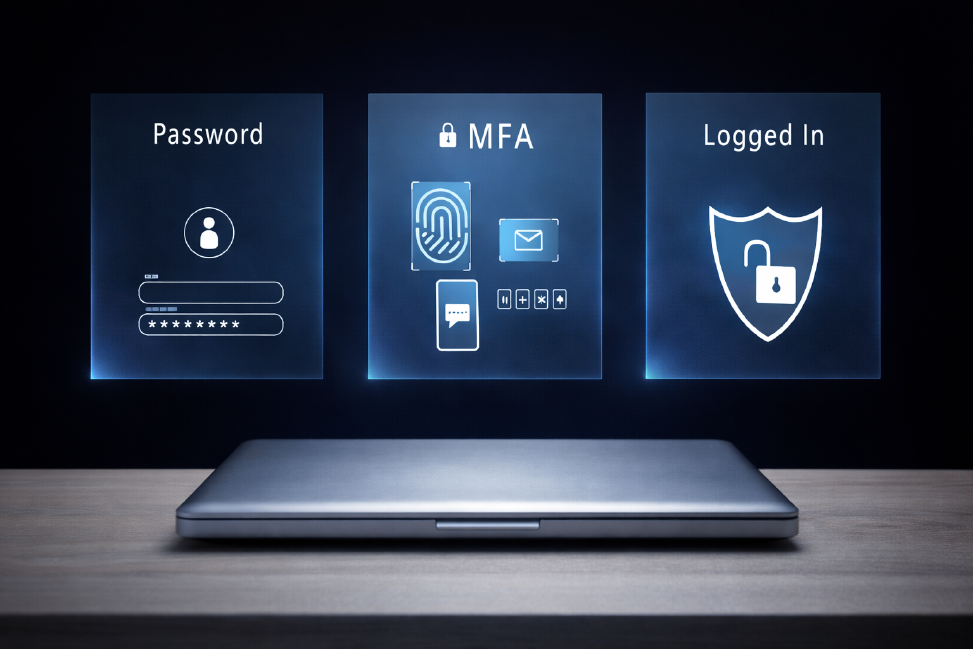
Multi-factor authentication (MFA) is considered one of the most important security mechanisms for protecting digital accounts today. By combining several independent factors, it makes it significantly more difficult for attackers to gain unauthorized access. However, despite this additional layer of protection, many organizations are asking themselves: Is MFA alone sufficient to reliably prevent modern attacks?
Why MFA is Considered an Important Security Standard
Multi-factor authentication (MFA) has become an important security standard in recent years. This is primarily because traditional authentication methods - especially the combination of username and password - are often no longer sufficient to reliably protect digital accounts. Stolen login credentials, phishing attacks, and automated credential stuffing attacks clearly demonstrate how vulnerable purely password-based login mechanisms can be.
MFA addresses this very issue by requiring additional proof of identity. Even if an attacker knows a user’s password, they typically need another factor, such as a registered device or a biometric characteristic. This significantly increases the effort required for a successful attack, preventing many automated or opportunistic attacks from the outset.
For this reason, numerous security guidelines and industry standards recommend the use of MFA as an additional security measure. Many cloud services, enterprise platforms, and online services now offer such procedures or even require them for particularly sensitive accounts.
For companies, the use of MFA therefore represents an important step towards securing user accounts, applications, and sensitive data. At the same time, the additional authentication layer helps to significantly reduce the risk of successful account takeovers.
How Good Are Multi-Factor Authentication Methods?
Despite its advantages, multi-factor authentication (MFA) is not a panacea. While Microsoft claims MFA can prevent more than 99% of automated account takeovers, it remains only an additional layer of protection within a comprehensive security strategy.
Over time, cybercriminals have developed various methods to specifically target or circumvent authentication mechanisms. For this reason, MFA is now considered an important, but not sufficient, component of a so-called defense-in-depth strategy, which combines several security measures.
Typical attack scenarios and challenges include, but are not limited to:
Phishing attacks:
Modern phishing campaigns can aim to intercept the second factor of authentication as well. In such cases, users enter their login credentials on deceptively authentic-looking websites, while attackers forward the authentication in real time and thus hijack a legitimate session.
Session hijacking:
Attackers attempt to hijack existing sessions by stealing session cookies or session tokens. Once a session is successfully established, access may be granted without having to complete the MFA process again.
Technical vulnerabilities:
Like any software, the implementation of authentication mechanisms can contain vulnerabilities. If these are discovered and exploited, security mechanisms can be bypassed.
Loss or compromise of the second factor:
If a device serving as the second factor—such as a smartphone or a hardware token—is lost, this can lead to access problems. In such situations, recovery processes are often used, which in turn require additional security considerations.
Furthermore, not all applications support modern or particularly secure MFA methods. In heterogeneous IT environments, this can lead to some systems having a lower level of security than others.
Examples of such attack methods, such as social engineering attacks or so-called adversary-in-the-middle techniques, are explained in detail in the article “Are Two-Factor Authentication Methods Generally Secure? Or What Does Social Engineering Have to Do with It?”
How Can I Make Sure That MFA is Secure?
Multi-factor authentication (MFA) is an important component of modern access security, but it should not be considered the sole security measure. Protecting digital identities requires several coordinated security mechanisms in practice. Many organizations follow concepts such as the Zero Trust principle, where every access request is thoroughly checked and not automatically deemed trustworthy.
An effective security strategy therefore combines MFA with other technical and organizational measures (TOMs). These include, among others:
Strong password policies:
In many systems, passwords still form the first step in the authentication process. If passwords are weak or reused multiple times, an attacker can relatively easily bypass the first login step and then focus on the second factor. Good password hygiene therefore remains an important security component, even with multi-factor authentication (MFA) enabled.
User security awareness:
A frequently underestimated factor is user behavior. If MFA is perceived as the sole protection mechanism, this can lead to a false sense of security. Training and awareness campaigns help to sensitize users to risks such as phishing, social engineering, and insecure password practices.
Phishing-resistant authentication methods:
Not all MFA methods deliver the same level of security. Methods such as SMS codes or telephone verification are now considered relatively vulnerable. Therefore, many organizations are increasingly relying on more secure methods such as authenticator apps, hardware tokens, or modern passwordless technologies – for example, passkeys based on FIDO2.
Consistent implementation and management of MFA:
For MFA to be effective, it should be consistently used – especially for privileged accounts, administrator access, or external access to company systems. Complementary features such as self-service password resets can help establish secure recovery processes while simultaneously reducing social engineering risks in support.
Monitoring login activity:
In addition to authentication itself, monitoring login events also plays a role. Systems for logging and analyzing login attempts can help to detect unusual activity early and react accordingly.
Conclusion: MFA is Necessary, But Not Sufficient
Multi-factor authentication (MFA) is a key component of modern access security and an important additional layer of protection for many systems. It significantly reduces the risk of automated attacks on user accounts and is therefore already a security standard in many organizations.
However, MFA alone does not constitute a complete security strategy. Attacks on the authentication process, human factors, or technical vulnerabilities can also affect systems with MFA enabled.
Effective protection of digital identities arises from the interplay of several measures. Multi-factor authentication (MFA) can only unfold its full potential within a comprehensive security architecture. At the same time, multi-factor authentication is now considered the minimum standard for protecting user accounts in many organizations.
At Engity, we are happy to support you in analyzing and developing a suitable security concept. Together with our clients, we select appropriate multi-factor authentication methods and the corresponding factors. In doing so, we consider both high security requirements and ease of use and user-friendliness for the users.